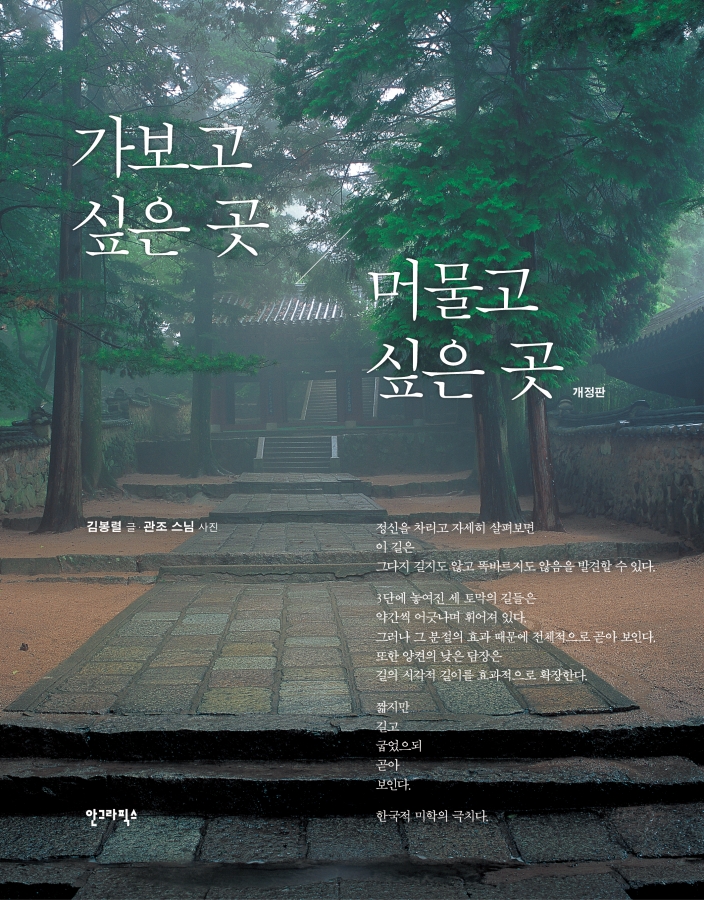
He graduated from Seoul National University with a bachelor’s degree in architecture and earned a Ph.D. in engineering from the same graduate school, and studied at the AA School of Architecture in the United Kingdom. He has served as a professor and dean of architecture at Korea National University of Arts, and chairman of the Cultural Heritage Committee of the Cultural Heritage Administration. Based on his deep knowledge in the field of ancient architecture, he is working to popularize architecture by combining architectural history research and design work. He has published more than 30 research papers, including “A Study on the Building Composition and Site Layout of Buddhist Architecture in Chosun Era throungh the Dogmatic Interpreteation” and “The Collective Types of Architecture in Temple Gowoon.” His books include Buddhist Architecture, Kim Bong-ryeol’s Korean Architecture Story, Places to Visit, Places to Stay, and the co-authored book The Craftsmanship of Our Time.
Authors
Kim Bong-ryol
김봉렬
다른 사람들
-
She studied journalism at Yonsei University and worked in marketing and public relations in the corporate world. While pursuing her master’s program in arts management at Carnegie Mellon University, she worked for the public art team at Pittsburgh City Hall and later worked as a design strategy manager in the corporate world. She is a graduate of the Gulbab Academy and currently works as a translator for BarTranslation.
-
Kim Min-jung
She has worked as an editor for various magazines from Casa Living to the monthly Design . She loves the eclecticism of magazines, is interested in how to translate design into language, and specializes in planning and creating content. She is currently the editor-in-chief of C , a magazine published by GrandeClip. -
Seo Ha-na
A Japanese translator and publishing editor who hovers between language and print. She considers language to be design, translating Japanese into Korean and plans books. She has worked in architecture and interiors, and after studying in Japan, she worked as an editor at Ahn Graphics. She has translated Rojinryoku , Who Made 501XX? , The Mina Perhonen Design Journey: The Circulation of Memory , An Encyclopedia of Tokyo Hotels , The Original Scenery of Harajuku in the 1970s , Walking with the … -
Shin Seung-won
An invited artist and judge for the Korea Calligraphy Grand Exhibition, recognized as Korea’s Outstanding New Intellectual for pioneering and promoting calligraphy education programs. Held solo exhibitions in 2015 at the Museo Nacional de Arte Decorativo and the Cultural Center of the Korean Embassy in Argentina, where two works, “Life” and “Ten Symbols of Longevity”, are now part of the permanent collection. Former director of the Pilmuk Calligraphy Research Institute, … -
Farah Kafei
Farah Kafei is a designer and art director who has led initiatives addressing gender disparity in design education and fostered communities pushing for a more inclusive industry. She’s had the pleasure of working for the Metropolitan Museum of Art and studios such as Sagmeister & Walsh and Doubleday & Cartwright. -
Rhi Joo-myung
Rhi Joo-myung studied industrial design at Seoul National University and design management at Leicester Polytechnic in the UK. He joined LG Electronics when it was called Geumsung and gained practical experience in planning and product design for over 9 years. He taught product design, design methods, and design management at Inje University and now at Yonsei University Wonju Campus. He has long been interested in the qualitative nature of design and hopes to better understand the … -
Roel Klaassen
Roel Klaassen is Programme Manager at Premsela, Dutch Platform for Design and Fashion. Roel is a design enthusiast with an academic background in design, psychology and strategic management. At present he’s working on the People’s Republic of Design programme, a Premsela initiative that aims to stimulate the development of an open design culture. -
Pyo Hyun-myung
President of KT. In 2004, during his tenure as Vice President of Marketing at KTF, he played a pivotal role in introducing service design into corporate management and marketing activities in Korea. Drawing on his extensive experience as a corporate leader, he applied service design to KT’s innovations, leading to the creation of iconic branding campaigns such as Have a good time (2005), SHOW (2007), QOOK (2009), and the groundbreaking exclamation olleh (2010). These efforts marked a … -
Karl Gerstner
Karl Gerstner (1930–2017) was a leading representative of Swiss typography and one of the most important innovators of typography, advertising graphics and corporate design. From 1945 to 1948, he completed an apprenticeship in Fritz Bühler’s studio and attended courses at the Allgemeine Gewerbeschule Basel, where Armin Hofmann and Emil Ruder were his instructors. In 1949 he followed Max Schmid’s call and joined the legendary design team of Geigy Pharmaceuticals, where he later met … -
Han Baek-jin
Graduated from the Graduate School of Industrial Arts at Hongik University and has been actively involved as a member of the Korean Society of Brand Design, the Korean Society of Basic Visual Design, and VIDAK, as well as an invited designer at the Korea Industrial Design Exhibition. In 2005, served as a visiting professor at the University of Washington (UW) and is currently a professor in the Department of Visual Design at Dankook University’s College of Arts. Authored Brand Package … -
Jeong Eun-ju
Jeong Eun-ju graduated from Korea University with a B.A. in English Literature and completed an M.A. program in Performing Arts at Seoul National University. She currently works as a freelance translator and editor. She has translated books such as GRAPHIC and other magazines and exhibition catalogs, as well as Ways of Hearing , Invisible , Never Use Futura , Encyclopedie Artwork Books , and The White Review Interviews . -
Arumjigi
The Arumjigi Foundation is a non-profit organization established in November 2001, dedicated to creatively preserving and passing down Korea’s traditional culture. Its mission is to rediscover the identity of Korean culture and cultivate new cultural heritage for future generations. Through efforts to care for Korea’s traditional cultural heritage and its surrounding environments, Arumjigi seeks to ensure that the values of tradition remain alive in modern life across clothing, …